
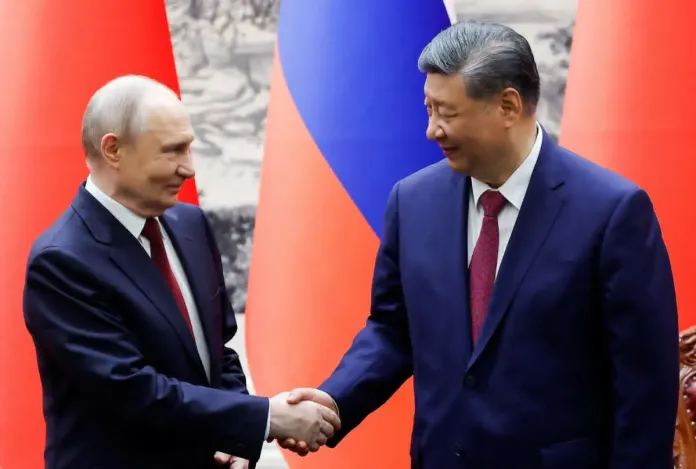

BEIJING – Less than a week after US President Donald Trump departed Beijing claiming “fantastic trade deals,” Chinese President Xi Jinping rolled out the red carpet once again — this time for Russian President Vladimir Putin. The back-to-back summits, separated by just five days, have placed Xi at the centre of global diplomacy in a way few leaders have managed in recent memory, and have prompted renewed scrutiny of exactly what was — and was not — agreed when Trump and Xi met at Zhongnanhai on May 15.
Putin arrived in Beijing on Tuesday for a one-day state visit, greeted with a military band and a red carpet ceremony that bore a striking resemblance to the welcome extended to Trump the week prior. In their opening remarks, Xi lauded the “unyielding relationship” between China and Russia, while Putin declared that bilateral ties were at an “unprecedented” high. Together, the two leaders issued a joint statement warning against a global return to the “law of the jungle” — widely interpreted as a direct rebuke of Washington — and criticised the expiry of the last remaining US-Russia nuclear arms control treaty, which lapsed in February after Trump declined to extend it.
The optics of the week have been impossible to ignore. Xi has effectively positioned China as the indispensable power in a fractured world: willing to engage Washington on trade and Iran, while simultaneously deepening strategic ties with Moscow. It is a balancing act that raises pointed questions about the durability of any commitments made during Trump’s visit.
What Happened at Zhongnanhai on May 15 The final day of the Trump-Xi summit was, by any measure, one of the most closely watched diplomatic encounters of the year. After two days of formal talks covering trade, Taiwan, and the ongoing war in Iran, Xi invited Trump for a private walk through the centuries-old gardens of Zhongnanhai — the walled compound adjacent to the Forbidden City that serves as the headquarters of the Chinese Communist Party. Such access is exceptionally rare; Xi himself noted during the stroll that very few foreign leaders had ever been received there.
The exchange was broadcast live on News24 — the East West Media Group’s 24-hour news channel — carried via the AP Direct feed, which went live at 9:27 AM BST. The pool spray coverage ran continuously and without interruption through the entire bilateral session, capturing President Trump’s remarks on Iran as they happened, unfiltered and in full. A hot mic caught the two leaders admiring trees that Xi said were over 1,000 years old. Trump asked whether other foreign leaders were received in the compound. “Very rarely,” Xi replied. He then invited Trump to touch a 280-year-old tree. “Good. I like it,” Trump said. It was a moment of warmth that stood in contrast to the harder edges of the negotiations taking place behind closed doors.
The Iran Question Remains Unresolved Iran dominated both summits. During his time in Beijing, Trump claimed that Xi had assured him China would not supply military equipment to Tehran, and that the Chinese leader had expressed willingness to help broker a peace deal and reopen the Strait of Hormuz. The Chinese Foreign Ministry, characteristically more measured, called for “a comprehensive and lasting ceasefire” and urged that shipping lanes be reopened “as soon as possible.” This week, with Putin at his side, Xi reiterated the ceasefire call — telling his Russian counterpart that “resuming hostilities is even more inadvisable.” Yet China’s position has remained carefully non-committal, stopping well short of the active pressure on Tehran that Washington has sought. Analysts note that Beijing continues to be the largest buyer of Iranian oil, a leverage point it has shown little appetite to deploy on America’s behalf. A Summit of Atmospherics, Not Architecture The broader assessment of the Trump-Xi summit, now sharpened by the events of this week, is one of managed stability rather than structural breakthrough. Trump touted deals in agriculture, aviation, and artificial intelligence, and both sides agreed to frame their relationship as one of “constructive strategic stability.” But the core tensions — over tariffs, technology export controls, Taiwan, and Iran — remain largely unresolved.
For Xi, the choreography of the past week has been near-perfect. He received the American president with imperial-era symbolism and personal warmth, extracted no significant concessions, and then welcomed his Russian counterpart days later to signal that China’s strategic options remain wide open. Whether Trump’s Beijing visit ultimately yields the concrete outcomes the White House has promised is a question that will take months, not days, to answer.
Additional reporting by Reuters and AFP.
