
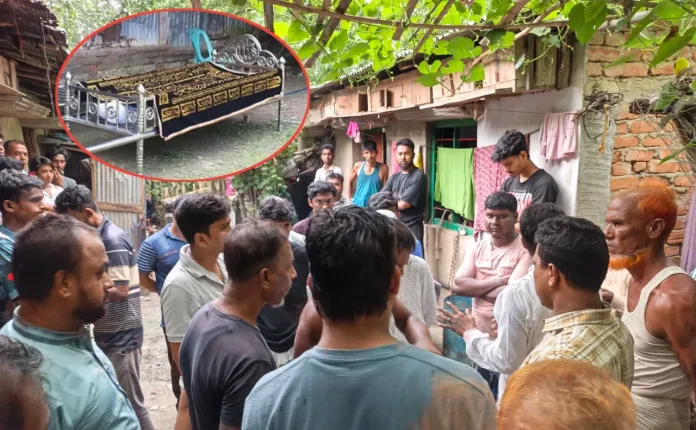

Hours of uncertainty over burial; family forced to lay her to rest at the foot of a hill amid allegations of extortion and social discrimination
One of the most fundamental rights at the end of a person’s life is a dignified burial. However, in the case of a housewife from Anwara upazila in Chattogram, that right has become the center of controversy, anger, and serious humanitarian questions. Family members allege that local community leaders refused permission to bury her in the community cemetery after her death. Following hours of unsuccessful negotiations, the family was ultimately forced to bury her at the foot of a nearby hill.
The incident took place in Fakirkhil area under Ward No. 7 of Bairag Union in Anwara. The deceased, Hizbul Bahar (42), died at around 9:00 a.m. on Saturday while undergoing treatment at Chattogram General Hospital. According to relatives, disputes over her burial began shortly after news of her death reached the village.
Lived in the Community for Nearly Three Decades
Family members said Hizbul Bahar’s father, the late Syed Fazlul Haque, married her to the late Abdur Rashid in 1996. Due to a lack of adequate residential land at her husband’s family home, she and her family continued to live at her parental residence after marriage.
According to relatives, she had lived in the area for nearly 30 years and actively participated in community events, religious functions, and social activities. Despite this long-standing presence, they claim she was denied recognition as a registered member of the local community when it came to her burial.
The family questioned why someone who had fulfilled all social obligations throughout her life was denied a place in the community cemetery at the time of her death.
Burial Permission Denied
Following her death, relatives approached community leaders seeking permission for burial in the local cemetery. They allege that their requests were repeatedly rejected.
According to the family, community leaders cited the deceased’s status as a non-listed community member as the reason for refusing burial rights. Despite repeated appeals and mediation efforts, the decision remained unchanged.
As the dispute continued, tension spread throughout the area while the family struggled to find a solution.
Allegations of Financial Demands
The family further alleges that they had previously been asked to pay a substantial fee or contribution in order to be officially included in the community register. They claim that because they were unable to pay the demanded amount, they were never formally recognized as members, leading to the denial of burial rights.
However, no formal statement from the community leaders regarding these allegations was immediately available. Locally, it is understood that their position is that cemetery space is limited and reserved primarily for registered community members.
Altercation and Assault Allegations
The dispute reportedly escalated into a heated confrontation between the deceased’s relatives and community leaders.
Family members allege that the deceased’s brother, Rokon, was assaulted during the argument. They specifically named community leaders Jamshad, Tipu, Gias Uddin, and several others in connection with the incident.
Police Intervention Failed to Resolve the Crisis
Local sources said that after learning about the situation, a police officer from Anwara Police Station attempted to mediate.
According to those familiar with the matter, the officer appealed to community leaders on humanitarian grounds, requesting that they allow a burial space for the deceased. Despite these efforts, the community leaders reportedly remained unwilling to change their decision.
As a result, the family arranged an alternative burial site at the foot of a nearby hill, where Hizbul Bahar was eventually laid to rest.
Following the incident, other local residents came forward with complaints regarding the community’s management practices.
One elderly woman claimed that her husband had been removed from the community register after temporarily moving away from the village. When he later passed away, the family reportedly faced similar difficulties regarding burial arrangements.
Another woman alleged that families not listed as community members are also deprived of access to water from a government-installed deep tube well.
The controversy has also sparked debate regarding ownership of the cemetery land.
Community leaders reportedly maintain that the land is privately owned and was designated for use as a community cemetery. Therefore, they argue that decisions regarding its management fall under the authority of the community.
In contrast, several local residents claim the land is actually government-owned khas land or part of public hill land that has been used by local residents for many years before being declared a community cemetery by previous generations.
Observers say official land records would need to be reviewed to determine the true ownership status of the cemetery.
