

Behind every statistic is an empty chair at the dinner table, a parent who never made it home, or a young dream buried too soon. Over the past decade, Bangladesh’s highways have quietly turned into a relentless tragedy, where a simple morning commute or a routine ride home carries a terrifying toll. Day after day, reckless driving, unsafe vehicles and crumbling roads shatter unsuspecting families, leaving thousands to grieve in silence. This persistent nightmare continues to rob the nation of its future—leaving every traveler to wonder if they will make it back to their loved ones.
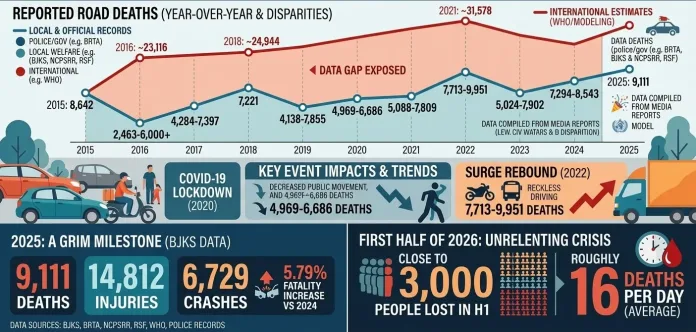
The seeds of this ongoing emergency were starkly evident in 2015, when compiled data revealed 8,642 deaths and 21,855 injuries across the nation. By 2016, the toll remained grim as estimates ranged from 2,463 police-recorded deaths to over 6,000 reported by welfare groups, while global health modeling placed the number as high as 23,116. Media monitoring in 2017 painted an equally bleak picture, recording between 4,284 and 7,397 fatalities. The carnage continued unabated in 2018 with at least 7,221 deaths across 5,514 crashes, and official counts in 2019 reached up to 7,855. Even the nationwide COVID-19 lockdowns of 2020 failed to halt the bloodshed, as restricted movement still saw between 4,969 and 6,686 people perish on surprisingly empty roads.
As public life resumed in 2021, local safety groups recorded up to 7,809 deaths, while international estimates surged to a heartbreaking peak of 31,578 fatalities. The crisis reached a lethal tipping point in 2022, when an influx of uncertified motorcycles and rampant reckless driving claimed between 7,713 and 9,951 lives in a single year. Disparities in tracking continued into 2023, contrasting official counts of 5,024 deaths against advocacy reports of 7,902 lives cut short. By 2024, highway fatalities escalated further to between 7,294 and 8,543. The devastation deepened sharply in 2025 as 9,111 people were killed—a 5.79 percent jump from the previous year—alongside 14,812 injuries in 6,729 crashes. The tragedy shows no signs of slowing in 2026, with nearly 3,000 lives already lost in just the first six months, averaging roughly 16 devastating deaths every single day.
As transport experts and safety advocates desperately plead for stricter traffic laws, safer highways and sweeping structural reforms, one harrowing truth remains: every single day of delay costs human lives. Behind these expert warnings are grieving mothers, orphaned children and broken families left pick up the pieces of preventable tragedies. Until those in power turn these urgent calls for action into uncompromising enforcement, our highways will continue to bleed—and innocent lives will remain the collateral damage of inaction.
