
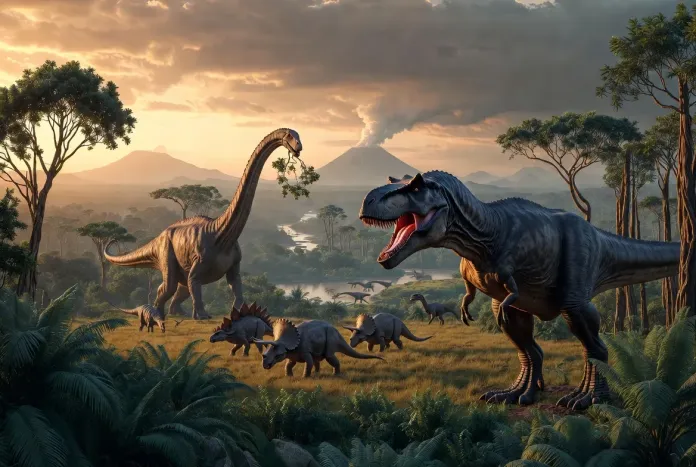

Dinosaurs dominated our planet for over 160 million years, from the late Triassic period through the Jurassic and Cretaceous periods, until a catastrophic event wiped them out about 66 million years ago. The word “dinosaur” comes from the Greek words deinos (terrible or fearfully great) and sauros (lizard). These incredible creatures continue to fascinate scientists, children, and adults alike through fossils, movies, museums, and ongoing discoveries.
The Age of Dinosaurs (Mesozoic Era)
Dinosaurs first appeared around 230–240 million years ago during the Triassic Period. At that time, all continents were joined in a supercontinent called Pangaea. Early dinosaurs were relatively small and agile compared to their later descendants.
Triassic Period (252–201 million years ago): The birth of dinosaurs. Species like Eoraptor and Herrerasaurus were among the first.
Jurassic Period (201–145 million years ago): Often called the “Golden Age” of dinosaurs. Huge sauropods roamed the lush forests, and predators like Allosaurus thrived.
Cretaceous Period (145–66 million years ago): The peak diversity. Iconic species such as Tyrannosaurus rex, Triceratops, Velociraptor, and Spinosaurus lived during this time. Flowering plants also began to spread, changing the ecosystem.
Major Groups of Dinosaurs
Dinosaurs are broadly classified into two orders based on hip structure:
•Saurischia (“lizard-hipped”)
Theropods: Mostly bipedal carnivores. Examples include:
Tyrannosaurus rex: Up to 40 feet long, with teeth the size of bananas and a bite force stronger than any living animal.
Velociraptor: Small, intelligent, feathered predators made famous by Jurassic Park.
Spinosaurus: The largest known carnivorous dinosaur, possibly semi-aquatic.
•Sauropods: Massive, long-necked herbivores.
Argentinosaurus and Patagotitan: Among the largest land animals ever, reaching lengths of 100+ feet and weights up to 70–100 tons.
Brachiosaurus and Diplodocus: Iconic giants with incredibly long necks for reaching high vegetation.
•Ornithischia (“bird-hipped”)
Triceratops: Three-horned, tank-like herbivores that lived in herds.
Stegosaurus: Famous for its plated back and spiked tail.
Ankylosaurus: Armored dinosaurs with club-like tails for defense.
Hadrosaurs (duck-billed dinosaurs): Some had elaborate crests used for communication or display.
Modern science has revealed that many dinosaurs, especially theropods, had feathers or feather-like structures. Birds are considered living dinosaurs — the only group that survived the mass extinction.
Behavior and Lifestyle
Diet: Carnivores, herbivores, and omnivores existed. Some hunted in packs, others were solitary.
Intelligence: Troodontids and dromaeosaurs (like Velociraptor) had relatively large brains and may have been quite clever.
Reproduction: They laid eggs in nests, and some species showed parental care, similar to modern birds and crocodiles.
Speed and Strength: Many could run fast; Velociraptor relatives were agile hunters. Sauropods relied on sheer size for protection.
The Great Extinction
Around 66 million years ago, an asteroid roughly 7–10 miles wide slammed into what is now the Yucatán Peninsula in Mexico, creating the Chicxulub crater. The impact triggered massive earthquakes, tsunamis, wildfires, and a “nuclear winter” effect as dust blocked sunlight for years. Volcanic activity in India (Deccan Traps) may have worsened the situation.
This event killed about 75% of all species on Earth, including non-avian dinosaurs. Small mammals, birds, and some reptiles survived and later diversified.
Fascinating Facts
The smallest known dinosaur was Oculudentavis — about the size of a hummingbird.
Some dinosaurs had incredible lifespans and grew continuously throughout their lives.
Fossil evidence shows dinosaurs suffered from diseases like arthritis and even had tumors.
More than 1,000 dinosaur species have been named, but scientists estimate thousands more remain undiscovered.
Dinosaur fossils have been found on every continent, including Antarctica.
Dinosaurs in Popular Culture and Science Today
From Jurassic Park and The Land Before Time to documentaries like Planet Dinosaur, these ancient giants captivate millions. Advances in paleontology using CT scans, 3D modeling, and genetic studies (though true cloning remains science fiction) continue to reveal new details. Recent discoveries include feathered dinosaurs in China and massive bone beds showing herd behavior.
In many ways, studying dinosaurs helps us understand evolution, extinction risks, and climate change — lessons vital for our own future.
