
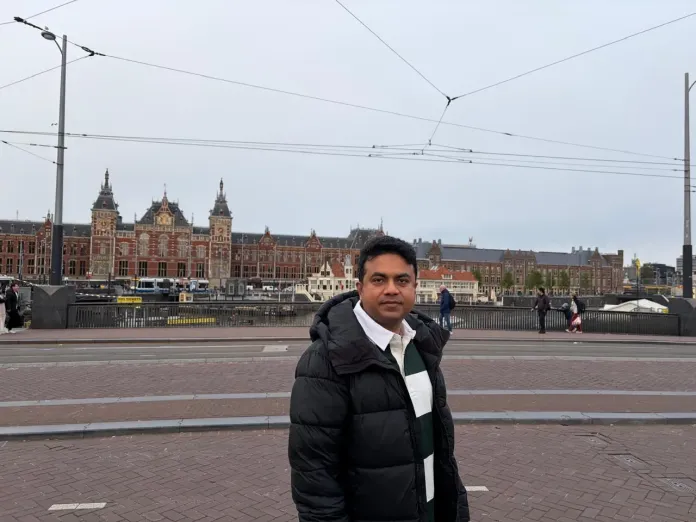

Stockholm, Sweden: Md Razibul Islam is an emerging Bangladeshi researcher building a multidisciplinary academic profile at the intersection of sustainable development, business leadership, circular economy, financial sustainability, sales and distribution, supply chain management, and digital transformation.
Islam’s academic journey began in Bangladesh, where his educational background includes studies at Khulna University and Independent University, Bangladesh (IUB). He later pursued higher education in Sweden and is currently associated with Södertörn University, Stockholm, where his recent research focuses on Leadership for Sustainable Development. Moreover, Islam has extensive experience across versatile functions of sales and distribution operations in multiple national and multinational organizations, with proven track records in financial inclusion, financial services, fintech, telecom, food, and FMCG industries.
A distinctive feature of Islam’s research is his effort to connect management and leadership with technology-driven sustainability solutions. His work examines how organizations can become more resilient, resource-efficient, and environmentally responsible while adapting to rapid technological change.
One important area of his research is sustainable supply chain management. Using a system dynamics perspective, his work explores how leadership decisions, collaboration, resilience, and sustainability practices interact within complex supply chain networks. Rather than viewing sustainability as an isolated environmental objective, his research considers the broader relationships among organizational strategy, technology, resources, and stakeholders.
Islam has also contributed to research on the circular economy and sustainable industrial transformation. His work highlights strategic vision, innovation capability, organizational culture, and stakeholder collaboration as crucial factors in helping industries transition from conventional linear production models toward more circular and resource-efficient systems.
Another significant dimension of his research involves the application of Multi-Criteria Decision-Making (MCDM). By incorporating methods such as DEMATEL and the Analytic Network Process (ANP), his work evaluates economic, environmental, social, governance, and technological factors to support more structured decision-making for sustainable development.
His research portfolio continues to expand into emerging technologies. Recent collaborative work involving blockchain and machine learning explores their potential to strengthen security, transparency, traceability, and information sharing in digital supply chains. He has also contributed to research concerning next-generation plastic recycling and circular economy pathways, further broadening the environmental and industrial scope of his work.
Beyond publishing research, Islam is actively engaging with the broader international academic community. His scholarly activities include peer-review engagements and participation in international academic conferences, complementing his growing publication portfolio.
Although his research career is still developing, the interdisciplinary nature of his work gives it increasing relevance. Contemporary sustainability challenges demand more than environmental policies alone; they require a deep understanding of leadership, digital technology, analytics, organizational behavior, and industrial systems. Islam’s research brings these domains together within a unified, sustainability-focused agenda.
From his academic foundation in Bangladesh to his current research activities in Sweden, Md Razibul Islam is developing an emerging international research profile focused on turning sustainability principles into practical, data-driven, and technology-enabled solutions. His evolving work reflects the vital role of researchers who can bridge management and technology to address the complex sustainability challenges facing modern organizations and industries.
